01 / DNA
The regulatory code.
From promoters and regulatory activity to disease-associated variants and long-range interactions.
20 task types55 settings
From sequence to biological function. A systematic benchmark of foundation models across DNA, RNA and protein.
DNARNAPROTEINOne shared perspective.
01 / THE BIGGER PICTURE
A model's value depends on the biological question. GenomicTouchstone brings diverse tasks into a shared framework, while preserving the protocols that make each comparison meaningful.
From promoters and regulatory activity to disease-associated variants and long-range interactions.
Connecting sequence with RNA processing, transcript behavior, translation and engineering.
Evaluating sequence representations through protein function, localization, stability and molecular properties.
Dataset settings include different lengths, sources and split protocols; they are not all independent data sources. Models are evaluated within their applicable protocols.
02 / THE LEADERBOARD
43 models. 100 shared settings. Compare fine-tuning results across the benchmark, or focus on the biology that matters to you.
Download rankings| Rank | Model | Mean rank ↓ | Top scores | Settings |
|---|---|---|---|---|
| Loading the leaderboard… | ||||
Loading results…
Each setting contributes equally. Top scores count settings where a model shares the highest mean; ties count for every tied model. Model search preserves the full-cohort ranks.
Models are ranked within each setting using full-precision accepted mean scores: AUPRC for classification and Spearman correlation for regression, both higher is better. Exact ties receive average ranks. Aggregate ranks average those setting ranks with equal weight, then order them from lowest to highest.
The overall view includes 52 DNA, 33 RNA and 15 protein settings. It includes PhyloGPN and the restored OpenVaccine and Tc-riboswitches random settings. Linear probing, three independent long-range settings and task-specific references are outside this 43-model FT cohort.
Accepted historical learning-rate, seed and precision choices are retained; some were informed by test results. Seed SD describes the accepted repetitions, not a confidence interval. Settings include related datasets and split protocols. Select a setting and a model to inspect its recorded qualifications.
This is a website snapshot of the current 100-setting main table, separate from the earlier frozen 98-setting manuscript aggregate. Download scores, seeds, protocol notes and source hashes ↗
03 / THE TASK COLLECTION
Loading the task collection…
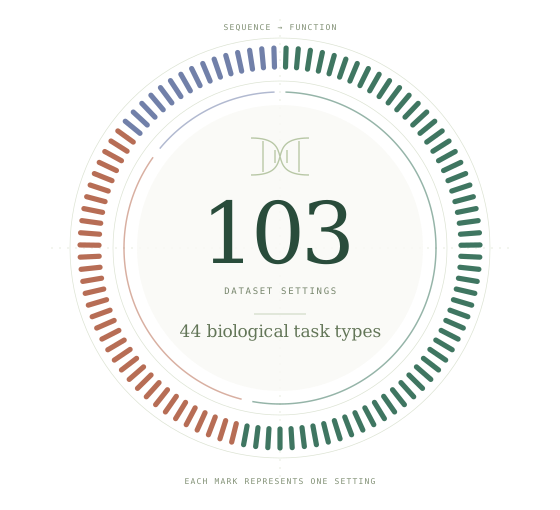
100 main settings + 3 long-range settings
04 / EVALUATION WITH CONTEXT
A benchmark is more than a leaderboard. Task definitions, adaptation methods and evaluation scope are part of the result.
Distinguish task types, source data and split protocols. Keep alternative settings visible instead of treating them as interchangeable.
TASK-AWARE DESIGNStudy fine-tuning, linear probing and task-specific methods within their supported evaluation scopes.
MULTIPLE EVALUATION MODESInterpret main-benchmark and long-range experiments separately. Model coverage and biological scope determine what a comparison can tell us.
SCOPE-AWARE INTERPRETATION05 / GO FURTHER
Explore the project code, inspect the task collection and build on the evaluation framework.